Introduction
Have you ever thought about how much energy it takes to run AI? With services like generative AI becoming more common, the demand for computing power—and the electricity to run it—is skyrocketing. Google is exploring a “moonshot” idea to solve this: Project Suncatcher1.
This project explores a radical new way to power our digital future by building AI data centers in space.
1. Overview: What is Suncatcher?
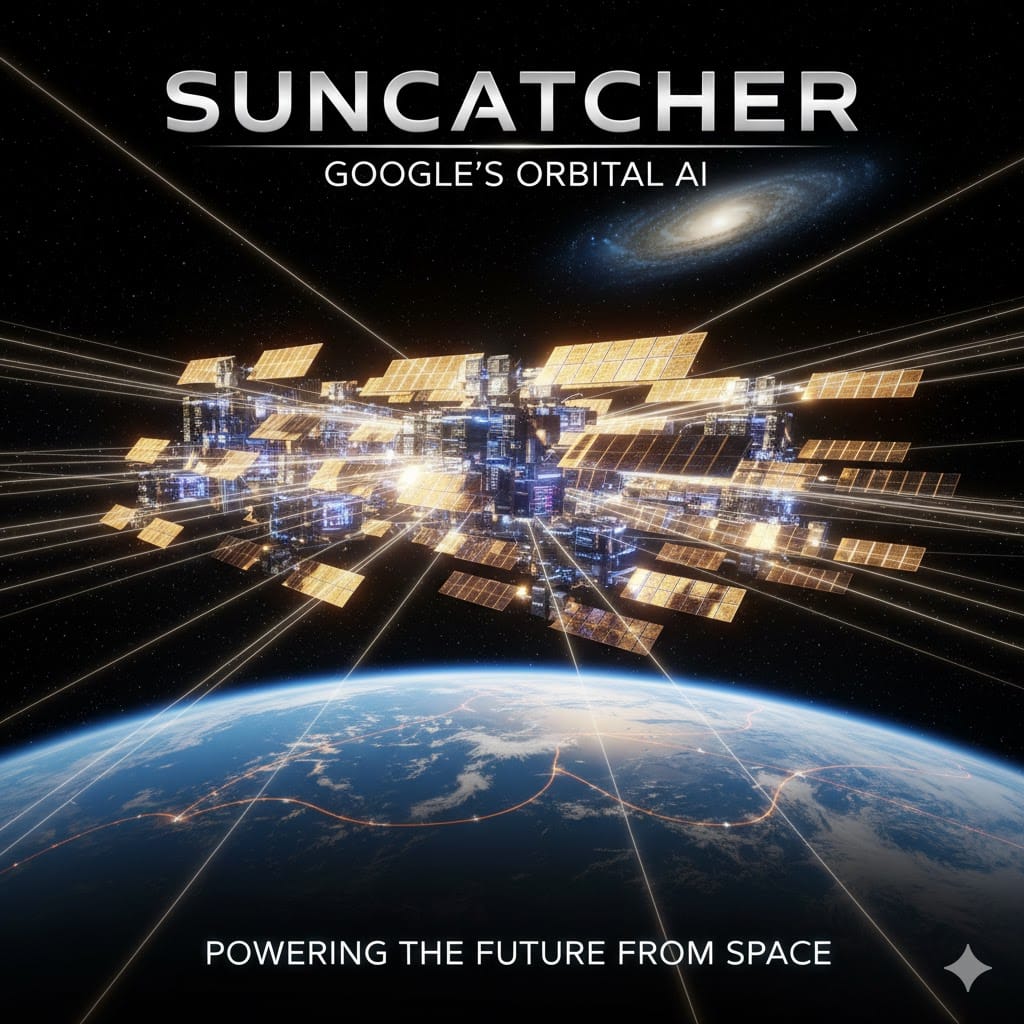
In simple terms, Suncatcher is a concept for a “highly scalable AI infrastructure system” that would orbit the Earth.
Instead of building massive data centers on land, Suncatcher would use fleets of satellites. Each satellite would be equipped with:
- Solar Panels to capture the Sun’s energy.
- Google TPU Chips (Tensor Processing Units) to run AI calculations.
- Laser Links (called free-space optics) to send data to other satellites at high speeds.
To make this work, the satellites would fly very close together in a “cluster” or “formation” (e.g., an 81-satellite cluster within a 1 km radius), allowing them to act like one giant, floating supercomputer.
2. The Need: Why Go to Space?
There are two main problems Suncatcher is trying to solve:
- Massive Energy Demand: AI is incredibly energy-hungry. The demand for AI computing has been exploding, leading to a “rapid increase in data center energy demand” on Earth.
- Strain on Terrestrial Resources: Building more data centers on the ground uses a lot of land and water (for cooling).
Suncatcher’s solution is to go directly to the source. The Sun is the “largest energy source in our solar system”. In a special orbit, solar panels can get “nearly continuous sunshine” and are “up to 8x more” effective than on Earth.
By putting the data centers in space, you use the solar energy right where you collect it. This avoids the massive challenge of trying to beam power from space down to Earth and frees up our planet’s resources.
3. The Approach: How Would It Work?
Making a space data center work requires solving some huge challenges. Here are the key approaches the paper mentions:
- Formation Flight: To get the high-speed, low-latency communication needed for AI, the satellites have to fly in a tight, “close proximity” cluster. The paper studies how to control an 81-satellite cluster within a 1 km radius. This formation would be managed by an ML-based flight control model to prevent collisions.
- Super-Fast Links: Current satellite links are too slow for AI. Suncatcher’s approach is to use off-the-shelf “free-space optics” (lasers), but by flying the satellites so close together (kilometers or less), they can achieve the massive 10 Tbps (terabits per second) bandwidth needed.
- Space-Ready TPUs: Can computer chips survive in space? Google tested its Trillium TPU accelerator chips against radiation. The results showed they “survive a total ionizing dose equivalent to a 5 year mission life” without permanent failures, making them viable for the project.
- The Right Orbit: The plan is to use a “dawn-dusk, sun-synchronous low-Earth orbit (LEO)”. This special orbit maximizes the satellites’ exposure to sunlight for power generation.
- Cost: A project like this is only possible if launch costs are low. The paper analyzes that if launch prices drop to about $200 by the mid-2030s (which is considered plausible), the cost of power in space could be “roughly comparable” to what data centers pay for energy on Earth.
4. Possible Alternatives: Why This Way?
The Suncatcher idea is different from other “space” solutions:
- vs. Space-to-Earth Power: Many have proposed collecting solar power in space and beaming it to Earth. The problem is that “getting the generated power back to Earth has been a major challenge”. Suncatcher avoids this problem by simply using the power in orbit.
- vs. “Monolithic” Space Stations: Why not build one giant data center in space? The paper calls this a “monolithic” approach. This would be incredibly complex, requiring “assembly in space by humans or robots”. Suncatcher’s “modular design” of many smaller, replaceable satellites is much easier to launch, manage, and scale up.
- vs. More Earth Data Centers: The alternative is to just keep building data centers on Earth. Suncatcher is proposed as a long-term, scalable solution that avoids the strain on land and water resources that this would cause.
5. Impact: What’s the Big Picture?
If Suncatcher is successful, its impact would be massive.
This “moonshot” is the “beginning of unlocking that potential” for a future where “the majority of AI computation happens in space”.
It represents a path to a “highly scalable AI infrastructure” that can grow to meet our future needs without being limited by our planet’s resources. By tapping directly into the “largest energy source in our solar system”, Suncatcher could power the next generation of artificial intelligence in a more sustainable way.
Author’s Thoughts
The Suncatcher paper’s point about minimizing the impact on terrestrial resources like land and water is more critical than it sounds. It’s easy for many of us to think of land as just… there. We don’t often treat it as a finite resource in the same way we think about oil or gas.
But the reality is, our population is constantly growing. More people mean an exponential increase in the demand for data, streaming, and AI. Meeting this demand requires more physical infrastructure—more massive data centers.
This creates a direct conflict. Land is a resource we all share. Every massive data center built is land that can’t be used for housing, agriculture, or conservation. Just like fossil fuels, land is not an unlimited resource. We are approaching a hard limit on how much of our planet we can dedicate to our digital needs.
This is why Suncatcher is so compelling. It’s not just solving an energy problem; it’s solving a physical space problem. It proposes a path where we can continue to scale AI and computing without paving over our planet to do it.
On a different note, managing the data in such a constellation presents its own challenges, like load balancing. One possible solution could be a hybrid model.
We could store the primary data in on-land data centers and use sharding (splitting the database) to share and sync only the necessary data segments to the satellite constellation. Once the computations are complete and the data is synced across all satellites, the original, uncompressed data on land could be offloaded or compressed, saving space.
To manage this, the use of blockchain could be valuable. A blockchain could create a secure, verifiable chain of data within the constellation. This would help reduce data redundancy, add a layer of security, and make referencing the original data on Earth much easier and more reliable.
References
[1] Research Paper: https://services.google.com/fh/files/misc/suncatcher_paper.pdf
[2] Blog: https://blog.google/technology/research/google-project-suncatcher/