The personal computer industry just experienced its most radical architectural pivot in forty years. At GTC Taipei, NVIDIA CEO Jensen Huang pulled back the curtain on the NVIDIA RTX Spark—an Arm-based System-on-a-Chip (SoC) designed in partnership with MediaTek.
The Spark isn’t just a faster processor; it is a full-scale migration of data center “superchip” engineering into thin-and-light consumer laptops. By combining enterprise-grade AI infrastructure with low-power silicon, NVIDIA and Microsoft are attempting to fundamentally change how computers function, shifting the user experience from an application-driven interface to a local, autonomous “agentic” environment.
Here is a technical deep-dive into the silicon, the software engineering, and why this design marks a historical turning point.
The Silicon Matrix: MediaTek’s Efficiency Meets Blackwell Muscle
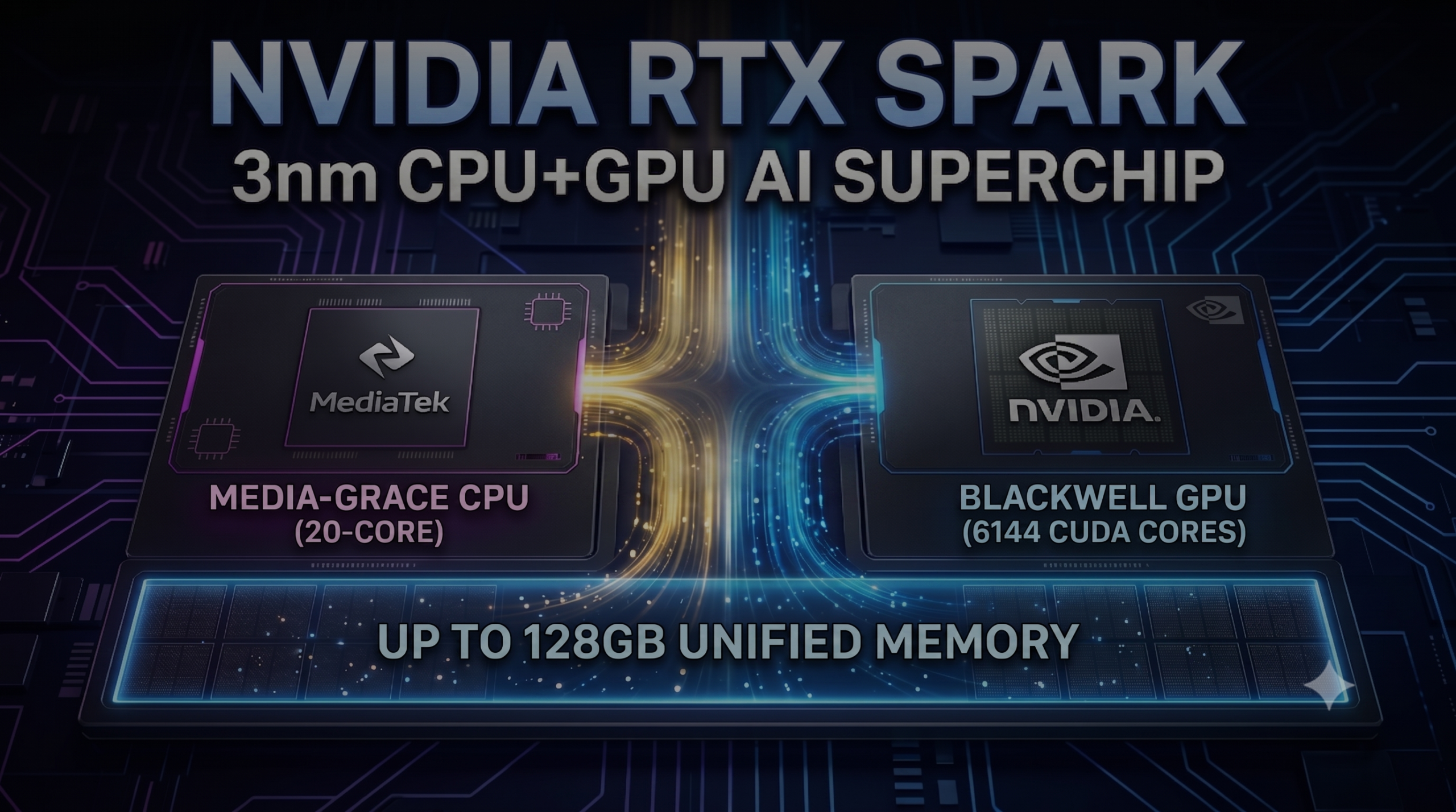
To build a chip capable of pushing 1 petaflop of local AI compute inside a 14mm laptop chassis without causing immediate thermal throttling, NVIDIA split the engineering duties down the middle with mobile chip giant MediaTek. Built on TSMC’s cutting-edge 3nm process, the RTX Spark architecture fuses two entirely different computing philosophies onto a single die.
The Compute Fabric
- The CPU Subsystem: A custom-designed 20-core Arm CPU that inherits architectural DNA from NVIDIA’s enterprise “Grace” architecture. MediaTek handled the physical layout and IP integration, drawing on years of smartphone power-management expertise to ensure the chip sips single-digit wattage during low-intensity tasks.
- The GPU Subsystem: A monstrous Blackwell RTX GPU packing 6,144 CUDA cores and fifth-generation Tensor Cores. It supports ultra-fast FP4 precision, giving it the brute strength required for real-time ray tracing and complex AI matrix multiplication.
The Interconnect and Unified Memory
The true engineering marvel of the RTX Spark lies in how these components communicate.
Traditionally, a PC’s CPU talks to a discrete GPU across a power-hungry PCIe lane, capped by a rigid video memory (VRAM) bottleneck. The Spark obliterates this layout using NVIDIA’s NVLink-C2C (Chip-to-Chip) interconnect, which links the subsystems at a blistering 600GB/s bandwidth.
Here is a detailed diagram illustrating the architecture of the NVIDIA RTX Spark (3nm) “superchip.”
Based on the architectural overview, this diagram visualizes how the individual components are integrated:
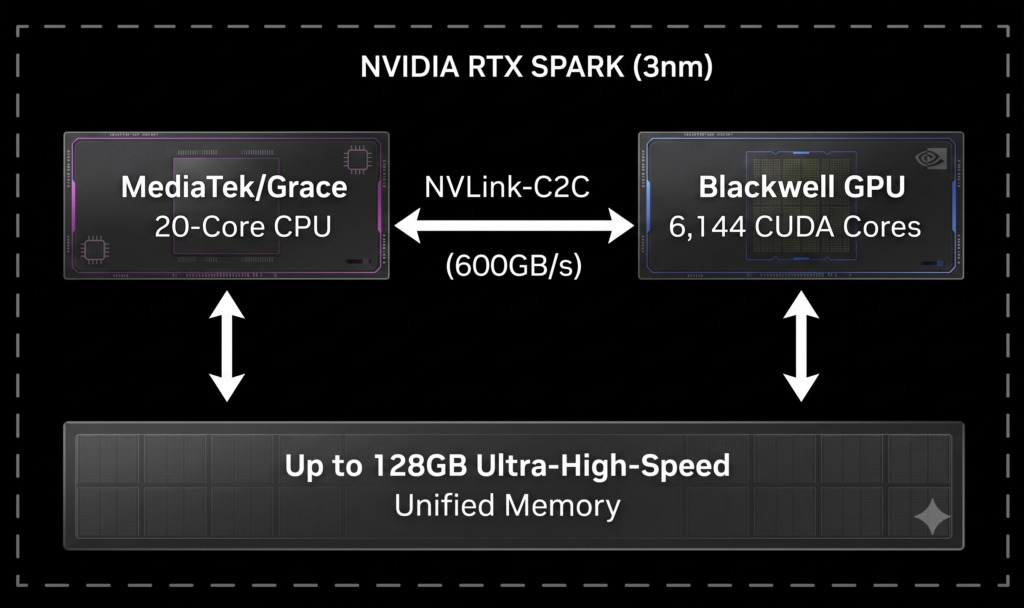
- Custom MediaTek/Grace CPU: The brain of the operation, featuring 20 custom Arm cores designed for general-purpose efficiency.
- Blackwell GPU: The muscle, packed with 6,144 CUDA cores and Tensor cores to deliver that 1 petaflop of local AI compute performance.
- Unified Memory Pool: Showing how the CPU and GPU access a shared, ultra-high-speed memory bank of up to 128GB, eliminating the bottleneck of typical discrete VRAM and standard system memory.
- NVLink-C2C Interconnect: The central high-speed bus that makes this architecture possible, moving data between the processor sub-systems at a blinding 600GB/s.
This high-speed bus feeds into up to 128GB of LPDDR5X unified memory. Because the GPU draws directly from the exact same memory pool as the CPU, creators and developers can load ultra-large 90GB+ 3D scenes or run local 120-billion-parameter Large Language Models (LLMs) with a 1-million-token context window—tasks that previously required an expensive, localized server tower.
The Windows Metamorphosis: From Apps to Agents
While the silicon footprint belongs to NVIDIA and MediaTek, the operating system overhaul belongs entirely to Microsoft. The RTX Spark serves as the launch platform for a modernized version of Windows 11 designed around an Agentic User Interface (UI).
Kernel-Level AI Integration
Microsoft has integrated new, hardware-accelerated security primitives deep into the Windows kernel. Paired with the NVIDIA OpenShell runtime environment, the OS can run completely private, autonomous AI agents locally on the device. Instead of sending sensitive emails, prompt histories, or corporate files to the cloud, the Spark processes these tasks locally. The OS paradigm shifts away from launching separate apps via mouse clicks, evolving into an ecosystem where you simply direct your local agent to execute complex multi-app workflows for you.
“For forty years, you launched apps. Click. Type. With RTX Spark and Microsoft Windows, you ask — and the PC does the work… This is the new PC. The personal AI computer.”
— Jensen Huang, NVIDIA CEO
Erasing the Arm Compatibility Penalty
Historically, Windows on Arm devices felt compromised due to lackluster software translation and restricted hardware choices. Microsoft and NVIDIA have targeted those pain points directly:
- Prism Emulation Upgrades: Microsoft heavily optimized its Prism x86-to-Arm emulation layer specifically to leverage the Spark’s architecture, allowing legacy Windows software to run natively with negligible performance loss.
- The Anti-Cheat Breakthrough: The fatal flaw of Arm gaming was that kernel-level anti-cheat programs refused to run on non-x86 architectures. Microsoft and NVIDIA successfully collaborated with developers to bring native Arm support to industry staples like Epic’s Easy Anti-Cheat and BattlEye. Popular competitive titles like Valorant and PUBG are now fully supported.
- Dynamic Power Allocation: Through Workload Profile Scheduling (WPS) and the Microsoft Power and Thermal Framework (MPTF), Windows dynamically routes threads between MediaTek’s efficient CPU cores and the Blackwell GPU, achieving true all-day battery life without sacrificing peak performance.
Why It Matters: A Tectonic Shift in Tech Power Dynamics
The arrival of the RTX Spark completely disrupts the traditional “Wintel” (Windows + Intel) duopoly that has governed personal computing since the 1980s.
By delivering desktop-class content creation capabilities—such as editing 12K video on battery power or playing AAA games at 1440p at over 100 FPS—NVIDIA has successfully crossed the chasm from being a mere graphics card supplier to a full-stack consumer platform architect. Meanwhile, MediaTek instantly secures a commanding foothold in the premium, high-margin PC market, and Qualcomm’s long-standing exclusivity over the Windows on Arm landscape officially comes to an end.
When the first wave of retail hardware drops this fall—spearheaded by Microsoft’s premium Surface Laptop Ultra alongside flagship entries from ASUS, Dell, HP, Lenovo, and MSI—we won’t just be looking at a new line of laptops. We will be witnessing the birth of an entirely new computing paradigm.
My Honest Review
Historically, integrated graphics (iGPUs) were bottlenecked because they choked on shared system memory bandwidth, while discrete graphics cards (dGPUs) wasted massive amounts of power moving data back and forth across a bottlenecked PCIe bus. By utilizing MediaTek’s low-power SoC layout to fuse the CPU and GPU via NVLink-C2C (600GB/s), it achieves the seamless data throughput of a high-end desktop supercomputer while scaling down to single-digit wattage during normal tasks.
User being able to game and work while running AI Agents to perform automations all within a lightweight laptop is truly amazing. As a software developer this capability means I can run powerful LLMs with large context and none of my data leaves my device for free. Rise in cost of Artificial Intelligence and AI Agents might just be perfect reason to have NVIDIA RTX Spark powered laptop for an engineer. Running a 120-billion-parameter model with a large context window on cloud APIs racks up massive, recurring monthly token bills. Shifting that workload to up to 128GB of Unified Memory on a local machine means the hardware essentially pays for itself over time. You are effectively trading expensive, recurring operational expenses (OpEx) for a one-time capital investment (CapEx) in a premium laptop.
As a developer, you cannot feed proprietary codebase architecture, private client data, or sensitive API keys into a public cloud LLM without violating compliance and security protocols.
Because Microsoft built new security primitives directly into the Windows kernel for this platform, your local AI agents (via NVIDIA OpenShell) can deeply index your local code repository and file systems. You get the power of an autonomous workspace assistant without a single byte of data leaving your machine.
The Verdict: If someone just needs to edit text documents or browse the web, a standard laptop is perfectly fine. But for an engineer who wants to build, test, and run locally automated dev pipelines with zero API latency and absolute data privacy—all while maintaining an ultra-thin laptop form factor—this architecture is a complete game-changer.
References:
Here are the official announcements, deep dives, and tech journalism coverages detailing the NVIDIA RTX Spark architecture, partnership, and operating system integration.
Official Announcements & Press Releases
- NVIDIA Newsroom: NVIDIA and Microsoft Reinvent Windows PCs for the Age of Personal AIThe primary press release outlining the collaboration with Microsoft and MediaTek, detailing local agent capabilities, Blackwell GPU integrations, and ecosystem timelines.
- MediaTek Product Hub: RTX Spark | Next Era of Windows PCsThe official product landing page breaking down MediaTek’s foundational contributions, including system integration, memory controller design, and power management.
Major Tech & Financial Publications
- PCMag: Nvidia Unveils RTX Spark, an Arm-Based Superchip for Windows PCsAn extensive overview detailing the silicon breakdown (N1X processor), form-factor targets, and how it impacts traditional x86 Windows gaming.
- Financial Times: Nvidia unveils PC ‘superchip’ in challenge to Apple and IntelA business-centric report framing the macroeconomic impact of the chip, its threat to Apple, Intel, AMD, and Qualcomm, and market stock reactions.
- TechPowerUp: MediaTek Collaborates with NVIDIA on RTX Spark to Power the Next Wave of Windows PC ExperiencesA hardware-focused report outlining MediaTek’s strategic push into the premium PC market and technical details on their proprietary PMIC and neural processing SDK alignments.
Architecture & Industry Analysis
- Architosh Silicon Analysis: NVIDIA unveils RTX Spark—ARM-based Superchip for Windows PCsA granular breakdown of the CPU layout (Cortex-X925 and Cortex-A725 cores), the NVLink bandwidth capacities, and what it means for the professional CAD and creative industries shifting away from x86.